Visitors find their way — in any building.
A map shows the way — the avatar answers the question. Your map material becomes an interactive wayfinding system with a talking avatar: visitors ask freely in natural language and are guided across 100+ languages — accessible and with no app at all.
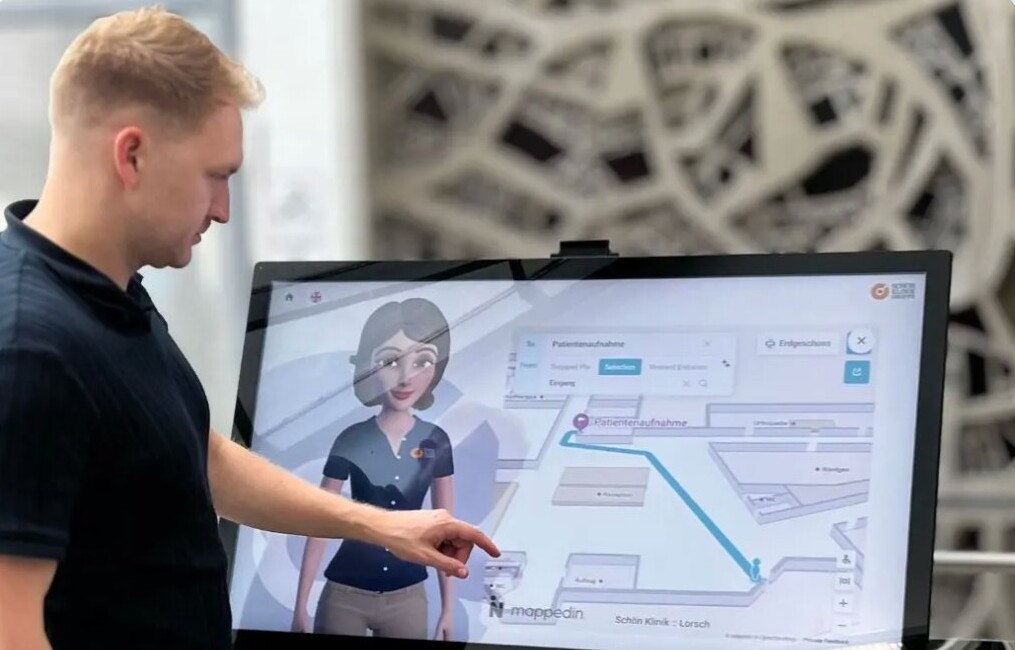 Indoor map · talking avatar
Orientation that thinks with you — not a forest of signs.
Fills the receptionist gap
Front-desk staffing is shrinking everywhere. The avatar is the always-available, human-feeling first point of contact — around the clock, the same at every site.
Removes the language barrier
Many visitors don't speak the local language. The avatar speaks theirs — instantly, across 100+ languages, with no extra staff.
Makes the map worth it
A static map is a cost. The avatar with a knowledge base gives specific, context-aware answers — turning the map material into real value.
The visitor journey — from entrance to destination.
Four steps, the same principle in every building.
Answers from the avatar
Visitors ask freely in natural language — by touch, across 100+ languages.
Route on the map
The interactive indoor map shows the way across floors and buildings.
Continue on your phone
The route moves to the smartphone and guides onward — without an app.
Arrive, and get more done
Plus services, promotions and hand-off to a human by phone or video call.
One system — many buildings.
Pick your building type — the solution adapts to visitors, routes and services.
Clinics & healthcare
Patients, visitors and suppliers find departments, wards and services — multilingual and accessible.
Learn more →Shopping malls
Visitors find stores, services and promotions; sponsor and ad space right at the point of contact.
Learn more →Airports
Travellers find gates, check-in, baggage claim and services — multilingual, across terminals and levels.
Learn more →Leisure venues
Museums, parks and pools guide guests to attractions, services and routes — in many languages.
Campuses & universities
Lecture halls, institutes, canteen and library — orientation for students and guests across the site.
Corporate campuses
Guests, candidates and suppliers are guided across the site to the right building.
Public buildings
Citizen offices, authorities and libraries guide visitors multilingually to the right desk, area or collection.
Stadiums & arenas
Block, seat, food and exits — guided, if you like, by your club mascot as an avatar.
Learn more →Mappedin's maps. Humanizing's delivery.
Mappedin provides the globally proven mapping foundation — in use at major airports, hospitals and shopping centers. Humanizing is the solution provider that turns it into a finished wayfinding system: we handle the integration end to end — from the conversational avatar and the knowledge base to the on-site hardware.
Together we bring indoor navigation and conversational AI into a single solution that operators can roll out without their own project team — a partnership model that scales with every new site.
 ×
×
What the interactive wayfinding system is made of.
Instead of menus and rigid commands, visitors speak freely: "I'm here, I'm looking for …". The avatar brings the map, knowledge base, FAQs and functions like ordering a taxi into one experience, understands context and guides to the goal. Hardware-independent in the browser, on any screen — and on request we run the entire kiosk fleet for you. Standard setup in days, not months.
Common questions about wayfinding.
An interactive wayfinding system guides visitors through a building — with a digital indoor map and a talking avatar that answers questions and shows the route. Instead of a static board, people get a route in their language, by touch or voice, and on request via QR code to their smartphone.
Any venue with footfall and orientation that needs explaining: hospitals, shopping malls, corporate campuses, universities, public buildings, libraries, leisure venues and stadiums & arenas. The system scales across floors, buildings and outdoor paths.
No. The avatar runs directly on a pillar, kiosk or wall display — usable instantly, no download. On request, the route is handed over to the visitor's own smartphone via QR code.
The underlying knowledge base can be maintained automatically from your own websites, so opening hours, offers and routes stay up to date. We maintain rebuilds and new routes in the map material as a service.
Yes. Voice control and high-contrast display follow accessibility guidelines, and operation is low-barrier. Hosting is in Germany, data stays in the EU, processing is GDPR-compliant.
Costs consist of a one-time setup per site, a monthly license and the modules you use. How large the investment is depends on building size, number of sites, depth of integration and features — and it scales with the value it delivers. In the intro call we put together a concrete configuration with a transparent quote.
Let's talk about your building.
In 30 minutes we'll work out whether an interactive wayfinding system makes sense for you — with a live demo. Directly with Thomas van den Berg, our senior solution architect, no sales pitch.