Patients and visitors find their way. Without asking your staff.
Charlotte is the interactive wayfinding avatar — multilingual, accessible, with a visual map and voice interaction. She relieves reception and staff from giving directions and answering routine questions, day in, day out.
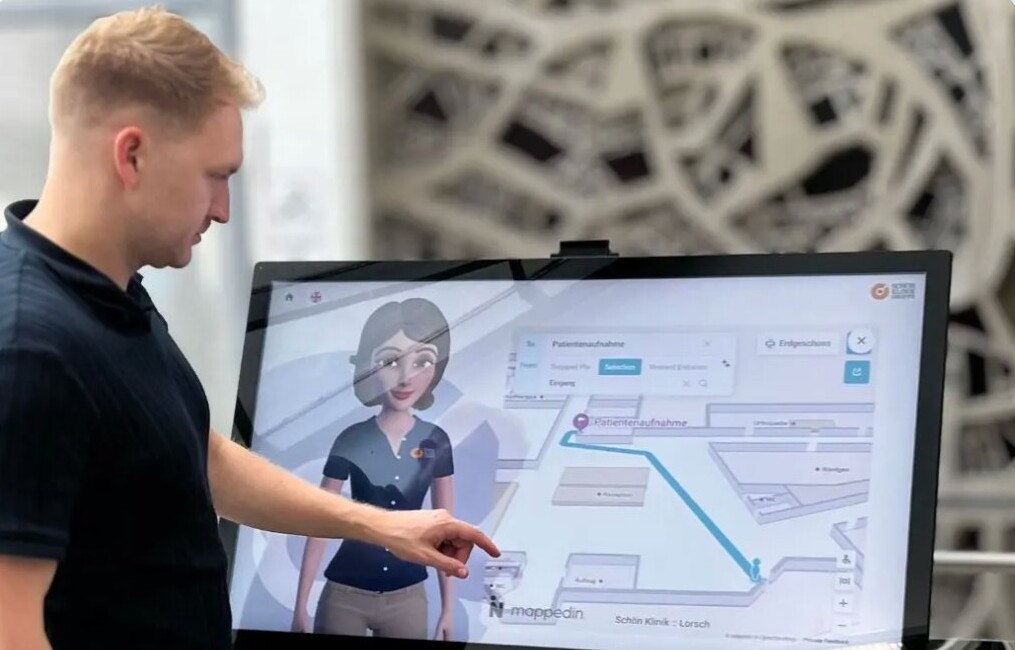 Live · Wayfinding with indoor maps
Three outcomes. Measurable per site.
Noticeable relief at reception
Directions, routine questions, admission preparation — today a job for your front desk, tomorrow a job for Charlotte. Your staff focus on what only they can deliver: empathy and complex cases.
Multilingual service without the language barrier
Charlotte answers in over 100 languages — Turkish, Ukrainian, Arabic, English and more. International patients and companions are understood without anyone having to translate. Accessible in line with BFSG.
Available 24/7 — nights and weekends included
Charlotte doesn't work in shifts. Suppliers, emergency visitors, patients with late appointments — everyone finds their way, even when reception isn't staffed. Service quality without extra headcount.
Four situations from the hospital.
Charlotte is not a screen with a search box. She is a guide who talks with patients and visitors — in their language, with a visual map, end-to-end.
Finds her department — without asking reception.
Appointment, floor, wing: Charlotte shows the route on the map and hands it over via print or QR code to the smartphone — across multiple buildings and outdoor paths.
An international patient without a language bottleneck.
Charlotte switches seamlessly across 100+ languages and resolves the request entirely in the visitor's language — e.g. Arabic, Turkish or Ukrainian.
Beyond wayfinding — cafeteria and taxi.
Charlotte knows the building's opening hours, services and procedures and triggers actions like ordering a taxi — end to end.
A supplier in the evening — when reception is closed.
After 6 pm, Charlotte directs suppliers to the goods-receiving area and announces their arrival to the shift on duty — without staff.
A hospital is an emotional place.
Patients often arrive worried, relatives under stress. That is why we build differently for hospitals than for train stations or government offices: Charlotte was developed and proven in daily hospital operations to take that reality seriously — as a guide and a receptionist in one.
The same pattern carries beyond healthcare: government offices, industrial receptions, tourism and libraries already use it in production.
Experience Charlotte live →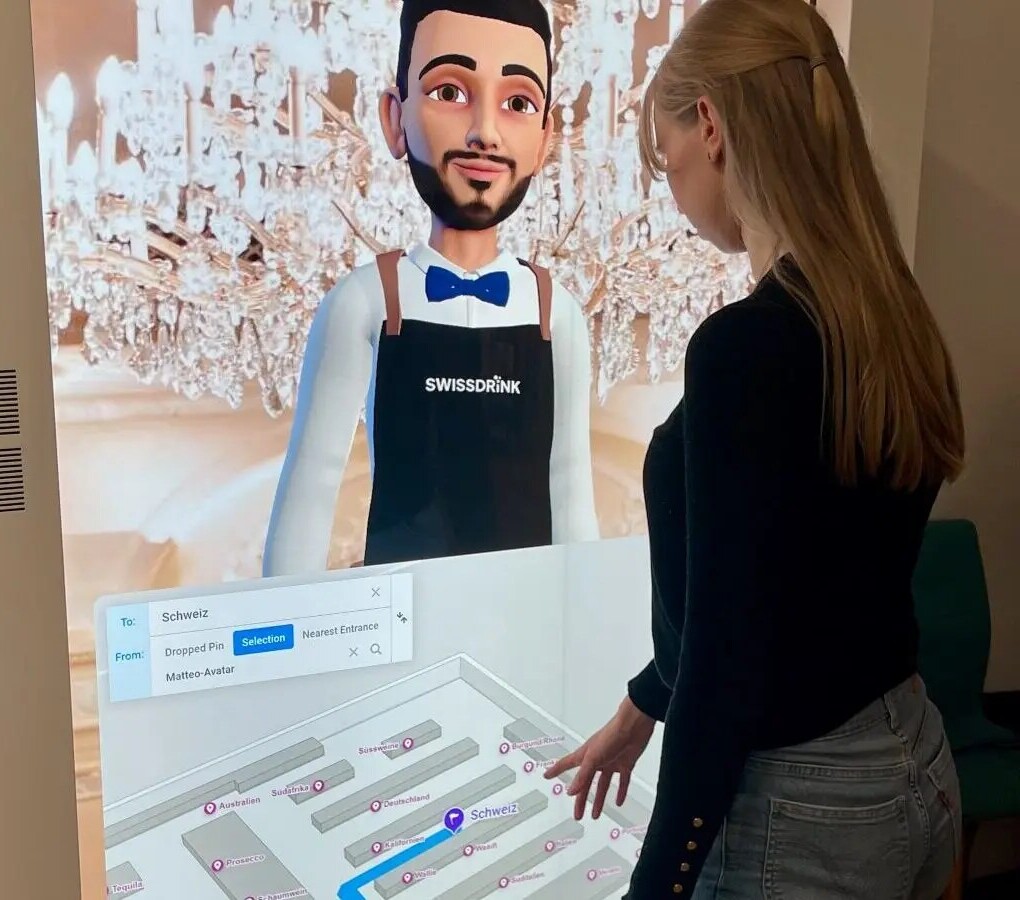
What Charlotte delivers technically.
Indoor maps for complex campuses
Real-time wayfinding across multiple buildings, floors and wings — including outdoor routes from the car park to the department.
Voice and touch operation
Patients can ask or tap. Voice control is especially relevant for people with mobility impairments.
QR handover to the smartphone
Patients take the route with them on their own phone — the guidance continues even after they leave the terminal.
Accessible in line with BFSG
High-contrast display, audio support, voice control — also suitable for visually impaired patients.
Optional integration with hospital systems
Subject to an individual project agreement, Charlotte can be connected to your HIS — for admission preparation or appointment confirmation, for example.
Maps adjustable afterwards
Renovations, new routes, temporary closures — we adjust the indoor maps for you afterwards, so the wayfinding always stays up to date.
With the innovative wayfinding system and avatar we were able to provide a 24/7 point of contact and greatly help our visitors find their way around our large buildings.
Four phases. First site first, roll-out after.
Intro call & demo
A 30-minute conversation with our senior solution architect. Live demo at a reference hospital, review of your building situation and the modules.
Map capture & configuration
Capturing your building plans (floors, wings, outdoor routes), configuration for your hospital, optional HIS integration, language and content tailoring.
First site live
Charlotte goes into production at your hospital. Supported by our solution architect, staff training, patient feedback, KPI monitoring.
Roll-out to further sites
Scaling across all facilities in your group. Standardized templates from the first site shorten each new one to a few weeks.
What hospital decision-makers ask first.
Costs consist of a one-time setup effort per site and a monthly license, plus the modules you actually use (multilingual pack, workflow avatar, video connect, etc.). How large the investment is depends on building size, number of sites, depth of integration and the features you want — and it scales with the value it delivers. In the intro call we put together a concrete configuration tailored to your hospital, with a transparent quote.
Yes. Renovations, new routes or temporary closures are handled by us afterwards — as a service by our team. This keeps the indoor map up to date without you having to maintain it yourself.
Yes. Voice control makes operation easier for people with mobility impairments, the visual presentation is high-contrast in line with BFSG requirements, and audio support can optionally be enabled. Also suitable for visually impaired patients.
Yes. Charlotte is hosted in Germany; all data stays within the EU. Processing is GDPR-compliant. Integration with your hospital information system (HIS) — for admission preparation or appointment confirmation, for example — is also possible subject to an individual project agreement.
German and English by default. The multilingual module adds over 100 more languages — Turkish, Arabic, Ukrainian, Russian, Polish, French and more. We configure the selection to match your patient demographics.
Charlotte runs on touchscreen steles, wall displays with speakers or kiosk systems. We provide hardware recommendations and can work with your existing infrastructure. Charlotte can also be handed over to the patient's smartphone via QR code — no additional hardware needed.
Typically 4 to 8 weeks from intro call to the first site live — depending on the complexity of the building, it can take a little longer. Map capture is the most time-intensive step. Follow-up sites within the same group go live significantly faster thanks to templates.
You know your hospital. We know wayfinding.
In 30 minutes we'll work out whether Charlotte makes sense in your hospital — with a live demo at a reference site. Directly with Thomas van den Berg, our senior solution architect, no sales pitch.