Charlotte: The Interactive Wayfinding System for Hospitals
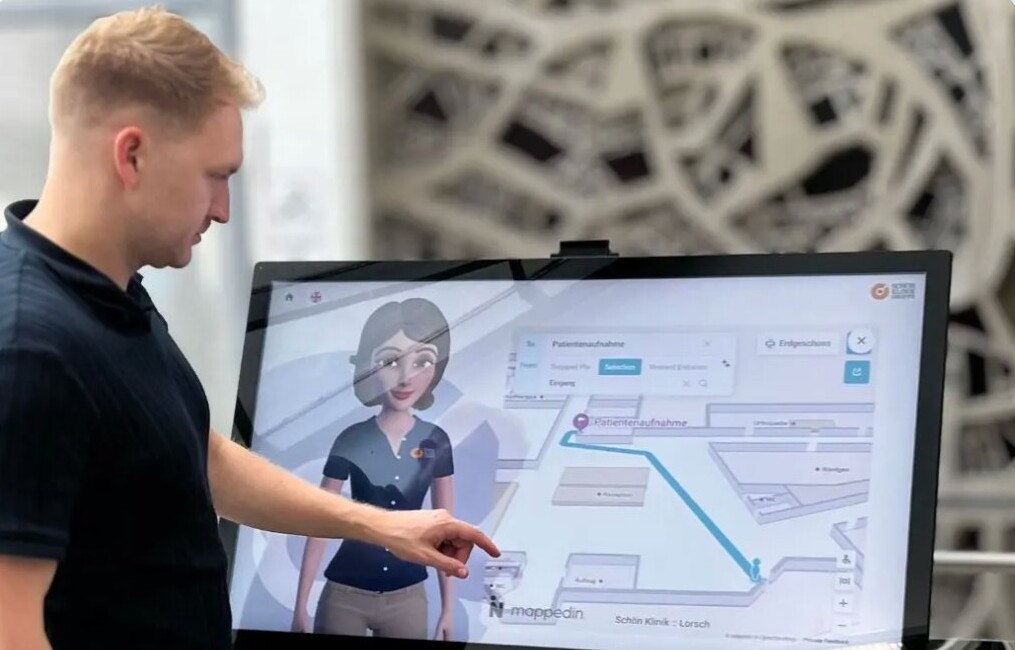
Charlotte is an interactive wayfinding system for hospitals, campus sites and public buildings. As a speaking avatar, she guides patients and visitors to their destination with a visual indoor map spanning multiple buildings and floors — operable by voice or touch, in more than 100 languages and accessible under the BFSG.
Unlike a static on-screen map with a search field, Charlotte talks to the people standing in front of her — in their language, with a visual map, and end to end. On request, she hands the completed route to a smartphone via QR code, so the guidance keeps working long after the patient has left the terminal. This relieves the reception desk of directions and standard questions — day after day, around the clock.
What is an interactive wayfinding system?
An interactive wayfinding system is a digital orientation aid that doesn't just show visitors a static plan, but, in response to a specific question, calculates the individual route and displays it visually. Charlotte is exactly that: a speaking avatar on a terminal, pillar or wall display that guides patients and visitors to their destination by voice or touch — across multiple buildings, floors and wings, including the outdoor routes from the parking garage to the department.
The difference from a classic site map lies in the interaction. Instead of reading a plan and orienting themselves, the visitor describes what they need in natural language — and Charlotte responds with the specific route. Especially in a hospital, where many people arrive worried or under stress, this removes a real hurdle from the first point of contact.
- Visual indoor map across multiple buildings, floors and wings
- Operable by voice or touch
- Outdoor routes from the parking garage to the department
- Route handed to the smartphone via QR code
How does a patient find their department?
The patient tells Charlotte their destination — for example, "I have an appointment in orthopedics" — and Charlotte shows the route immediately on the indoor map, with floor and wing. On request, she prints the route or hands it to the smartphone via QR code, so the guidance keeps working even after the patient leaves the terminal.
This is the most common case in everyday hospital life: appointment, floor, wing. This is exactly where giving directions at reception ties up staff today — and exactly where Charlotte steps in. She also covers routes across multiple buildings and outdoor paths, that is, the entire path from the parking garage or main entrance to the right door.
The benefit goes beyond the individual patient. Worried relatives who want to reach the right ward quickly, visitors with late appointments, or people standing in a large hospital campus for the first time — they all find their way independently, without having to queue or ask.
How does Charlotte help with language barriers?
Charlotte speaks more than 100 languages and switches seamlessly into the language of the person in front of her. A patient or companion who does not speak German describes their request in Turkish, Arabic, Ukrainian or another language — and receives the complete answer, including directions, in that same language.
In practice, this is a real bottleneck: reception cannot cover every language, and organizing a translation for every foreign-language companion costs time and ties up staff. Charlotte resolves the request directly at the terminal, with no one having to translate.
Which languages are offered prominently can be tailored to the patient demographics of the facility. This way, international patients and their relatives encounter orientation they understand from the very first second.
Is Charlotte accessible under the BFSG?
Yes. Charlotte is designed to be accessible in line with the requirements of the German Accessibility Strengthening Act (BFSG). The visual display is high-contrast, optional audio support can be activated, and voice control makes operation considerably easier.
Voice control in particular is relevant for people with mobility impairments who cannot comfortably reach a touchscreen — they can simply speak their request. Combined with audio output, Charlotte is therefore also suitable for visually impaired patients.
- High-contrast, BFSG-compliant display
- Optional audio support
- Voice control as an alternative to touch operation
- Suitable for visually and mobility-impaired patients as well
How is the indoor map maintained?
The indoor map is maintained as a service by the Humanizing Technologies team. Renovations, new routes or temporary closures are added afterwards — the hospital does not have to handle updates itself.
This keeps the guidance permanently accurate, even as the building changes. That matters in a hospital where wards relocate, construction phases are sealed off, or entire wings are newly developed. For groups with several facilities, templates from the first location significantly shorten the setup of subsequent locations.
How quickly is Charlotte ready to use, and what does she cost?
From the first coordination to go-live at the first location usually takes 4 to 8 weeks — somewhat longer depending on the complexity of the building. The most time-consuming step is capturing the building plans; configuration, language and content adaptation, and the productive launch follow.
The cost consists of a one-time setup effort per location and a monthly license. The base license starts at €500 per month and location; additional modules each have their own prices. A concrete configuration takes shape in the initial conversation, based on the structural situation and the desired functions.
Frequently asked questions
The cost consists of a one-time setup effort per location and a monthly license. The minimum base license starts at €500/month per location, and each module has its own price. In the initial conversation, we put together a concrete configuration for your hospital.
German and English by default. The multilingual module makes more than 100 additional languages available — Turkish, Arabic, Ukrainian, Russian, Polish, French and more. We configure the selection to match your patient demographics.
Yes. Voice control makes operation easier for people with mobility impairments, the visual display is high-contrast in line with BFSG requirements, and optional audio support can be activated. Suitable for visually impaired patients as well.
Yes. Charlotte is hosted in Germany, all data stays within the EU, and processing is GDPR-compliant. A connection to your hospital information system (HIS) — for example for admission preparation or appointment confirmation — is possible subject to an individual project agreement.
Yes. We add renovations, new routes or temporary closures for you afterwards — as a service by our team. This keeps the indoor map always up to date, without you having to handle the maintenance yourself.
Usually 4 to 8 weeks from the initial conversation to the first location going live — somewhat longer depending on the complexity of the building. Map capture is the most time-consuming step. Subsequent locations in the same group go live considerably faster thanks to templates.
See Charlotte — Wayfinding in action
Book a no-obligation intro call — we'll show you the use case live at your touchpoint.