Accessibility: Interactive Avatars under the BFSG
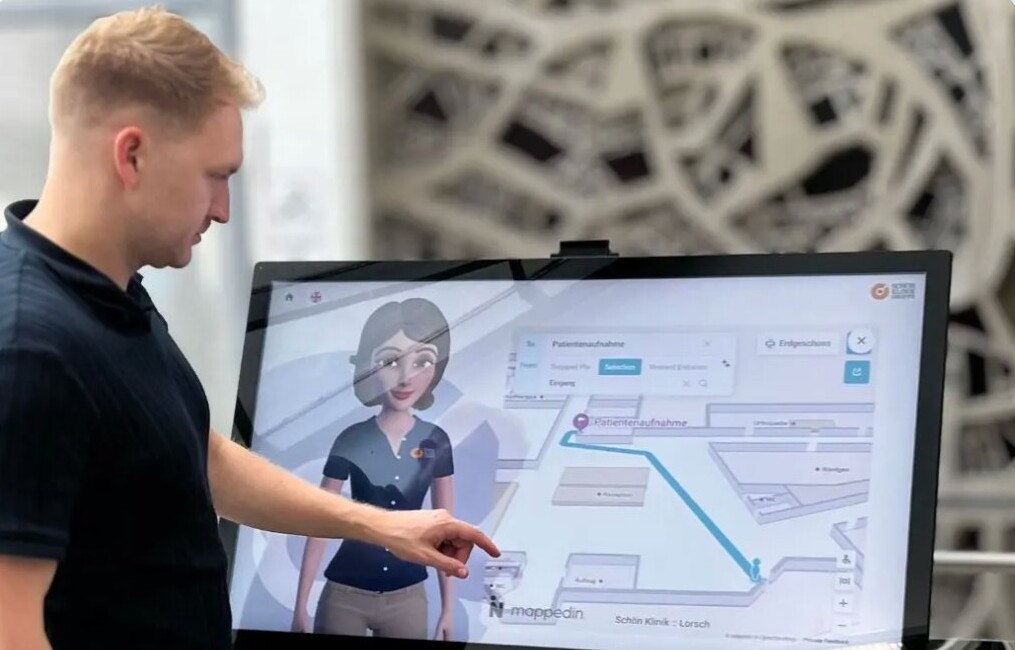
For interactive avatars, accessibility means that people with different abilities can use the digital assistant on equal terms — regardless of whether they have a mobility, vision or speech impairment, or do not speak German. To achieve this, an accessible avatar offers several equivalent ways to interact: voice control instead of touch, high-contrast display, optional audio output and more than 100 languages. The legal framework in Germany is the German Accessibility Strengthening Act (BFSG), the national implementation of the EU's European Accessibility Act (EAA).
This is not only a question of inclusion but, since 28 June 2025, also a legal obligation for many providers. The BFSG applies to a range of digital products and services — including self-service terminals and interactive systems such as those used in public buildings, banks and clinics. Interactive avatars like Charlotte are designed from the ground up to meet this standard and to make orientation accessible to all visitors.
What does the BFSG, or the European Accessibility Act, require?
The German Accessibility Strengthening Act (BFSG) is the German implementation of the European Accessibility Act (EAA), an EU directive for uniform accessibility of products and services across the internal market. It requires that certain digital products and services be designed so that people with disabilities can perceive, operate and understand them without outside help. The act has been in force since 28 June 2025.
Its scope includes, among other things, self-service terminals and interactive systems — that is, exactly the device class to which an avatar on a pillar or a touch display belongs. In practical terms this means: operation must not be tied to a single sensory channel. Anyone who cannot see, cannot hear, or cannot reach a touchscreen needs an equivalent alternative path to their goal.
- BFSG = national implementation of the European Accessibility Act (EAA)
- In force since 28 June 2025
- Covers self-service terminals and interactive systems, among others
- Principle: content perceivable, operable and understandable for everyone
How does an interactive avatar support people with impairments?
An accessible avatar offers several equivalent ways to interact, so that every visitor can choose the one that suits them. Voice control makes operation especially easier for people with mobility impairments who cannot comfortably reach a touchscreen — they simply speak their request and receive the answer. Those who prefer to type use touch operation.
For people with visual impairments, a high-contrast visual display in line with BFSG requirements, combined with optionally activatable audio support, ensures that the avatar remains usable even without precisely recognizing the screen contents. The spoken answer and the audio output make the information audible rather than only showing it visually.
- Voice control as an alternative to touch operation
- High-contrast, easily legible visual display
- Optional audio support for the output
- Suitable for people with visual and mobility impairments
How does multilingualism help accessibility?
Language barriers are one of the most common hurdles in the first contact with a building or institution. An avatar with more than 100 languages lowers this barrier by switching seamlessly into the language of the person it is talking to: anyone who does not speak German describes their request in their native language and receives the complete answer in that same language.
Accessibility is therefore to be understood more broadly than purely physical access. It also encompasses understanding information. For international visitors, patients or customers, this means they can manage on their own without relying on a companion or an interpreter.
- More than 100 languages, automatic switch into the language of the person
- Answer entirely in the chosen language
- Independent orientation without a companion or translation
Which institutions are affected by the BFSG?
The BFSG is relevant for many providers in the public and private sector — wherever visitors come into contact with self-service terminals or interactive systems. This typically includes public buildings and authorities, banks and financial service providers, as well as clinics and healthcare facilities.
It is precisely in these environments that very different people come together: older visitors, people with disabilities, international guests and individuals arriving under stress. An accessible avatar covers this range with a single system while at the same time ensuring that the legal requirements are met.
- Public buildings and authorities
- Banks and financial service providers
- Clinics and healthcare facilities
Is Charlotte accessible under the BFSG?
Yes. Charlotte, the interactive wayfinding system from Humanizing Technologies, is designed to be accessible in line with the requirements of the BFSG. The visual display is high-contrast, audio support can be optionally activated, and voice control offers a full-fledged alternative to touch operation.
Charlotte thus unites the central requirements for accessible self-service systems in a single device: several equivalent ways to interact, a design suitable for people with visual and mobility impairments, and more than 100 languages that break down language barriers. In this way it offers orientation that truly all visitors can use.
Frequently asked questions
The German Accessibility Strengthening Act (BFSG) is the German implementation of the EU's European Accessibility Act (EAA). It requires that certain digital products and services — including self-service terminals and interactive systems — be usable in an accessible way. The act has been in force since 28 June 2025.
Yes. Charlotte is designed in line with the requirements of the BFSG: high-contrast visual display, optionally activatable audio support and voice control as an equivalent alternative to touch operation. This way the avatar can be used through several ways to interact.
Voice control makes it possible to simply speak a request instead of having to operate a touchscreen. This makes use easier especially for people who cannot comfortably reach a display — for example wheelchair users or people with limited fine motor skills.
Yes. The high-contrast display in line with BFSG requirements and the optionally activatable audio support make the avatar usable even without precisely recognizing the screen contents. The information is output audibly, not only shown visually.
Multilingualism breaks down language barriers. The avatar switches seamlessly into the language of the person it is talking to, so that even people without knowledge of German can describe their request and receive a complete answer in their language — independently and without a companion.
The BFSG is relevant wherever visitors come into contact with self-service terminals or interactive systems — typically in public buildings and authorities, at banks and financial service providers, and in clinics and healthcare facilities.
See Charlotte — Wayfinding in action
Book a no-obligation intro call — we'll show you the use case live at your touchpoint.