Why Interactive Avatars? Interactivity, Psychology and Acceptance
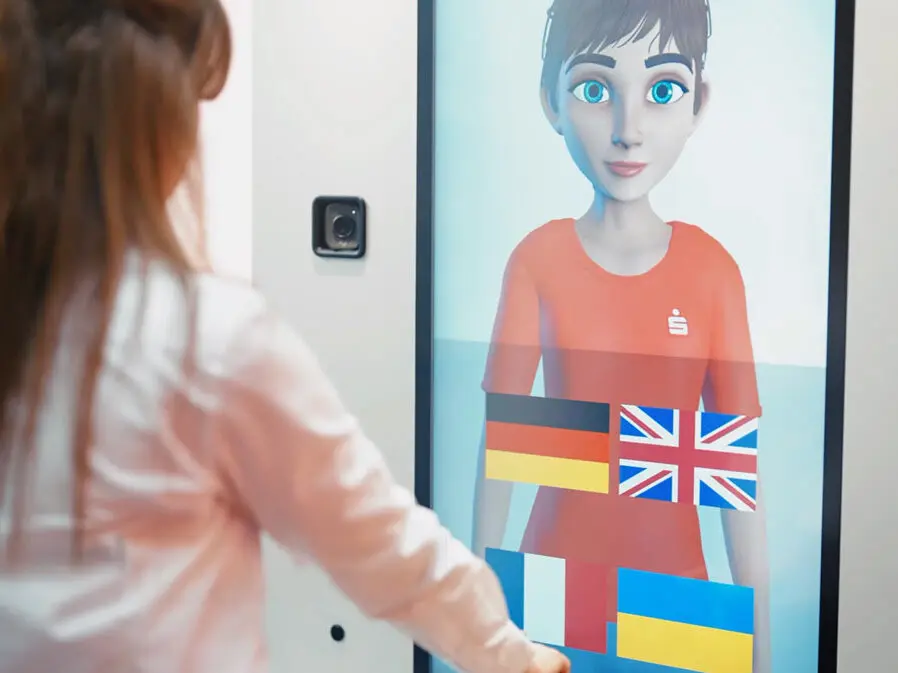
An interactive avatar is a digital, talking character that actively addresses people in public space, responds to their requests and completes tasks together with them. Unlike a silent screen or a form, it invites dialogue: it is interactive because it listens and answers, and proactive because it approaches people on its own — instead of waiting for someone to find the right button.
But why does it need to be a character at all? And why does a friendly, clearly cartoon-like avatar often work better at scale than a photorealistic face? This article explores the reasons for interactivity and proactivity in human-machine interaction, explains the deep-psychological effect of non-photorealistic avatars, honestly names the challenges of adoption, and closes with the advantages of interactive service points.
Why interactivity and proactivity in human-machine interaction?
Interactivity and proactivity close the gap between an offering and the person meant to use it. Classic technology in public space is passive: a terminal, a machine or a website waits for someone to find the entry point on their own, navigate to the right menu and know the right function. Anyone who is unsure, short on time or doesn't speak the language gives up — and the offering goes unused.
An interactive avatar reverses this logic. It responds in natural language to what a person actually wants and guides them step by step to the result. Proactivity adds that it takes the first step: it greets, offers help and thereby lowers the threshold to start at all. It is exactly this first impulse that decides whether a passer-by becomes a user.
- Passive technology waits — interactive technology answers
- Proactivity lowers the threshold for the first step
- Dialogue in natural language replaces searching through menus
Why do interactive avatars attract attention in public space?
A speaking, responsive face draws attention because our brains are evolutionarily primed to react strongly to movement, gaze and voice. Where dozens of screens with silent advertising are overlooked, an avatar that looks at people, addresses them and visibly responds to them sticks. It isn't perceived as yet another display, but as a counterpart.
This attention is not an end in itself. It is the precondition for a self-service offering to be used at all: first the avatar is noticed, then addressed, then used. In public space — in the branch, the foyer, at reception, at a trade fair — this effect turns passing footfall into real interaction.
- Gaze, movement and voice activate attention more than static displays
- The avatar reads as a counterpart, not an advertising surface
- Attention is the first step toward actual usage
Why are avatars a gateway to technology (accessibility)?
Avatars make technology accessible because they use the most natural interface people know: conversation. No one has to install an app, create an account, understand a menu or know the right technical terms. You say in your own words what you need — the avatar translates that into the appropriate process.
This lowers the barrier for groups often excluded by purely digital interfaces: older people, those with little technical experience, people with visual or reading impairments, and international guests who don't speak the local language. Speech and image together, in over 100 languages and at your own pace, turn an exclusive offering into an inclusive one.
- Conversation instead of menus — no app, no account, no jargon
- Multilingualism opens access for international users
- Image and speech together also reach less tech-savvy groups
Why do non-photorealistic avatars work better psychologically?
A deliberately stylized, non-photorealistic avatar is accepted at scale because it sidesteps three psychological traps that photorealistic faces fall into. First, the uncanny valley: an almost-real face that feels subtly wrong triggers discomfort. A clearly drawn character never opens that problem — it is recognizably a character and is allowed to be one.
Second, distrust of deepfakes: in an era of manipulated videos, a photorealistic face immediately raises the question of whether a real person is being deceptively imitated. An obviously artificial character is honest about what it is, and thereby creates trust instead of suspicion.
Third, the expectation of intelligence: a perfectly human face raises the expectation of human omniscience — and disappoints at every limit. A likeable character calibrates expectations realistically. If something doesn't work, that's forgivable: people forgive a friendly character a gap in knowledge, just as they would forgive a helpful robot. It is exactly this forgivability that keeps the interaction positive.
- No uncanny valley: a character is allowed to visibly be a character
- No deepfake suspicion: honestly artificial instead of deceptively real
- Realistic expectations: limits are forgiven rather than punished
Why do character avatars reduce shame, bias and judgment?
A character takes away the feeling of being judged. In front of another person, many hesitate to ask a supposedly stupid question, to ask again several times or to raise a sensitive matter — out of shame, out of fear of judgment or prejudice. An avatar doesn't judge, doesn't get impatient and treats everyone the same. This is the very strength that also speaks for a robot: it has no bad day, no prejudice and no rush.
Because the character also comes across as playful and friendly, the whole experience shifts from an obligation to a small positive moment. This gamification isn't about points or badges, but about the actual goal: to bring people joy instead of pressure. Someone who experiences an interaction as pleasant will use it again — and recommend it to others.
- No judgment, no impatience, no prejudice — the same for everyone
- Sensitive or repeated questions become easier without shame
- A playful, friendly experience: joy instead of obligation
What are the challenges of adoption?
The biggest challenge is not the technology but the first contact: people have to enter into the interaction in the first place. Not everyone spontaneously talks to a screen, and some cultures and situations are more reserved than others. Early on, many prefer to observe before they dare.
This hurdle can be designed for. A proactive but non-intrusive opening, good placement with a bit of privacy, visible examples of other users and a clear invitation lower the threshold noticeably. It's important to understand the avatar as a complement: it takes over routine and invites experimentation without replacing human contact where it is needed. Over time the interaction becomes familiar — and curiosity turns into habit.
- First contact is the real hurdle, not the technology
- Some users and cultures are more reserved — adapt the approach
- Placement, invitation and role models lower the threshold
What advantages do interactive service points offer?
Interactive service points combine the human accessibility of a conversation with the advantages of digital systems. They enable genuine self-service: recurring requests are handled directly on site, without a queue and without tying up staff. That relieves teams exactly where routine and language diversity create the greatest load.
On top of that come qualities that human advice alone cannot provide: the avatar is available around the clock, speaks over 100 languages, is highly adaptable to brand, content and processes, and is updated centrally and remotely — no maintenance staff is needed on site. Service quality thus scales across locations and opening hours, while personal contact stays free for the cases that truly need it.
- More self-service: routine requests without a queue
- Available 24/7 and multilingual
- Highly adaptable to brand, content and processes
- Central remote maintenance — no on-site maintenance staff
Frequently asked questions
An interactive avatar is a digital, talking character that actively addresses people in public space, responds to requests in natural language and completes tasks together with them. It is interactive because it listens and answers, and proactive because it approaches people on its own.
Deliberately stylized avatars sidestep the uncanny valley, deepfake suspicion and inflated expectations of intelligence. A recognizable character is allowed to be a character, reads as honestly artificial and calibrates expectations realistically — its limits are forgiven more readily than those of a deceptively real face.
Because they don't judge anyone: a friendly avatar doesn't judge, doesn't get impatient and treats everyone the same. That reduces shame and the fear of prejudice, makes even sensitive or repeated questions easier, and turns the interaction into a positive, playful moment — for young and old.
Gaze, movement and voice engage our perception more than static displays. An avatar is perceived as a counterpart, not an advertising surface — and this attention is the precondition for a self-service offering to be used at all.
The real hurdle is the first contact: people have to enter into the interaction, and some users or cultures are more reserved. A proactive but non-intrusive presence, good placement, visible role models and a clear invitation lower this threshold noticeably.
They enable genuine self-service for recurring requests, are available around the clock, speak over 100 languages, are highly adaptable to brand and processes, and are maintained centrally and remotely. Service quality thus scales across locations and opening hours.
See Interactive Avatars in action
Book a no-obligation intro call — we'll show you the use case live at your touchpoint.