Chatbot vs. video avatar vs. interactive avatar
Three terms are often blurred together, yet they mean very different things. A text chatbot is a written conversation: you type, and software replies in a chat window. A video/AI avatar is a pre-produced video with an AI face and an AI voice — perfect for playback, but unable to truly listen. An interactive (live-dialogue) avatar, by contrast, is a dialogue-capable real-time system with a face and a voice: it listens, answers freely in conversation and resolves cases end-to-end at the point of contact.
Which solution is right depends on the task — not on which technology happens to be trending. This article places the three types objectively: when is a chatbot enough, when does a video suffice, and when do you need a live avatar that genuinely speaks and acts? Humanizing falls into the third category and serves here as an example of the interactive, agentic, multilingual avatar.
What is the difference between a chatbot, a video avatar and an interactive avatar?
The difference lies in two dimensions: whether the interaction happens in real time — and whether the system only answers or also acts. A text chatbot holds a written real-time dialogue, but has no face and no voice. A video/AI avatar has a face and a voice, but is a playback video without genuine listening. An interactive avatar combines both: face and voice in free real-time conversation.
The decisive factor is agency. Many solutions only inform — they provide information or forward the request. An agentic avatar, by contrast, sees the case through: it clarifies the request, asks follow-up questions and completes the matter at the point of contact. It is precisely this step from informing to getting it done that separates a live avatar from a pure question-and-answer system.
When is a text chatbot enough?
A text chatbot is enough when the interaction is text-based, asynchronous and low-threshold — for example in a website's support widget, the help center or a messenger. Anyone who is already typing, sitting at a screen and looking for a quick piece of information is often well served by a good chatbot.
The chatbot reaches its limits wherever closeness, trust or accessibility matter: at the physical reception, with people who do not like or cannot type well, or when a request calls for a genuine conversation. A text window also cannot offer a face and a voice that hold attention and create a brand experience.
- Strong for self-service on the web and in the help center
- Cheap and fast for simple text-based information
- Weak at the physical point of contact and with language barriers
- No face, no voice, no brand experience
When does a video/AI avatar suffice?
A video/AI avatar suffices when the same message is to be produced once and played back many times — for instance for training, onboarding, product explanations or marketing clips. Here the video is an efficient lever: created once, voiced in many languages, played back as often as needed.
A video cannot listen, however. It does not respond to what the person in front of it actually says, and it does not handle an individual case. As soon as someone has a specific request and expects an answer or a completed case, the playback format reaches its limit — that calls for a genuine dialogue.
- Ideal for training, onboarding, explainer and marketing videos
- Produced once, multilingual, freely scalable
- Asynchronous — no listening, no response to the request
- Does not handle individual cases
When do you need an interactive live avatar?
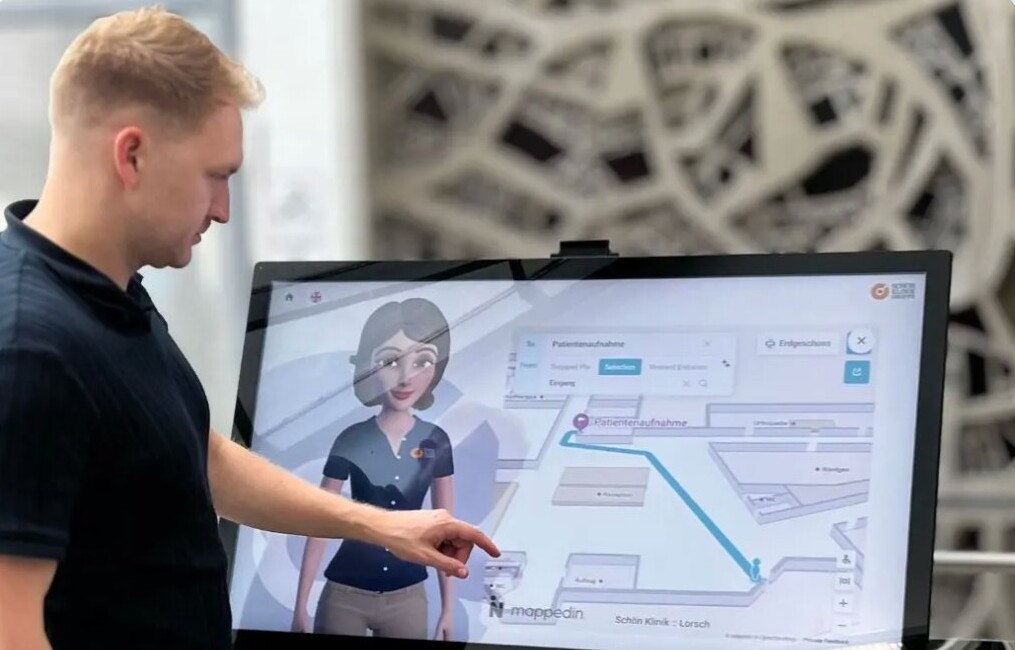
A live avatar is the right choice whenever a person at the point of contact has a specific request and immediately expects an answer or a completed case. It listens, answers freely, asks follow-up questions and sees the case through — like a human counterpart, only around the clock and identically at every location.
Humanizing avatars are built for exactly this: they speak over 100 languages, work agentically and end-to-end, run hardware-flexibly from the stele to the web, and are hosted in a GDPR-compliant manner in the EU or in Germany. For a quick, independent start there is the self-service variant Cosmo; larger initiatives are delivered by Humanizing as a guided project engagement.
- Reception, branch and factory gate: clarify requests and complete them directly
- Wayfinding and advice in the chosen language
- Self-service on the web that really gets things done
- Multiple locations with consistent quality, around the clock
How do the three solutions compare directly?
In a direct comparison, what matters is which properties your task requires. The following points show where the text chatbot, video avatar and interactive live avatar are each strong — and where they are not.
- Real-time dialogue: chatbot yes (text), video no, live avatar yes (spoken)
- Multilingualism: chatbot depends on the system, video per voicing, live avatar 100+ languages in conversation
- Agency: chatbot partly, video no, live avatar agentic and end-to-end
- Hardware/touchpoints: chatbot on the web, video playable anywhere, live avatar from stele to web
- Data protection: depends on the provider — Humanizing is hosted GDPR-compliantly in the EU/DE
- Effort: chatbot low, video a one-off production, live avatar fast as Cosmo or guided as a project
Which solution delivers which ROI?
Each of the three solutions raises ROI at a different point — which is why a combination often pays off more than an either-or decision. A chatbot lowers the cost of simple text-based information on the web. A video avatar, produced once, explains the same thing to many people — efficient for training and marketing.
An interactive live avatar takes effect at the real point of contact: because it resolves requests end-to-end, it relieves staff at reception, on the phone and in service, keeps waiting times short, and serves multiple languages without additional translation effort. Anyone who sensibly combines all three levels covers reach, explanation and genuine case processing together.
Frequently asked questions
A text chatbot holds a written dialogue without a face or voice. An interactive avatar holds a spoken real-time conversation with a face and a voice, listens, answers freely and resolves cases agentically and end-to-end at the point of contact.
No. A video/AI avatar is a pre-produced video that is played back and does not listen. A live avatar conducts an open real-time conversation and responds to what the person in front of it actually says.
When the interaction is text-based, asynchronous and low-threshold — for example in a website's support widget or help center. For the physical reception, with language barriers, or when a genuine conversation is needed, an interactive live avatar is the better fit.
Yes. Humanizing avatars speak over 100 languages in free conversation and switch language on request, without a separate video having to be produced for each variant.
That depends on the respective provider. Humanizing avatars are hosted in a GDPR-compliant manner in the EU or in Germany and are accessible in line with the BFSG.
No. The chatbot, video avatar and interactive live avatar solve different tasks and can be combined — for instance a video for a one-off explanation, a chatbot for web self-service and a live avatar for end-to-end advice at the point of contact.
See Humanizing Avatars in action
Book a no-obligation intro call — we'll show you the use case live at your touchpoint.