Lucas: The Truck Check-In at the Factory Gate for Industry & Logistics
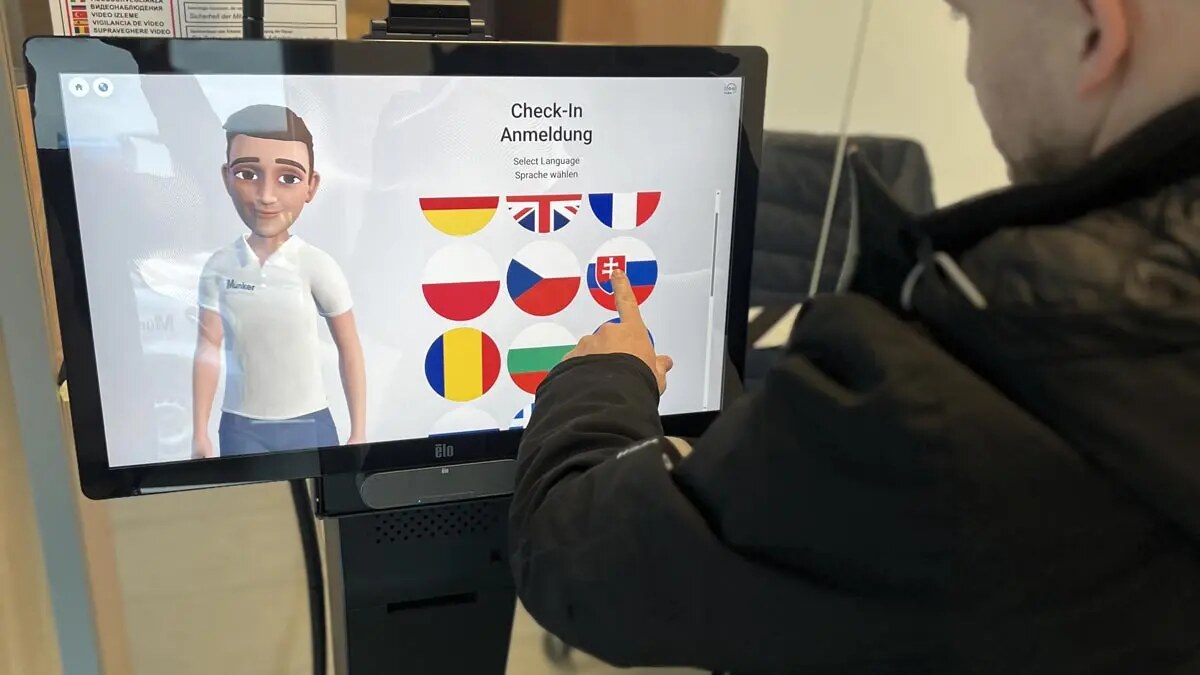
Lucas is the interactive check-in avatar for the factory gate. He registers truck drivers in their own language, runs the safety briefing and manages the queue and loading docks on the yard — from arrival through to a free dock. Lucas speaks more than 100 languages and comes with its own control dashboard.
Unlike a digital registration form with a language button, Lucas guides the driver through the entire site entry: registration in their native language, regular-driver recognition, documented briefing and dock assignment. This relieves the gatehouse exactly where language barriers and peak times put the most strain on day-to-day work at the gate — without anyone having to stand alongside.
What is the truck check-in with Lucas?
The truck check-in with Lucas is a digital registration process at the factory gate that welcomes truck drivers in multiple languages, runs the mandatory safety briefing and organizes the workflows on the yard. Lucas is the interactive avatar of this process — he handles registration, data capture and gate and dock assignment, and keeps an eye on the queue and dock status.
Lucas runs on rugged outdoor kiosks with a touchscreen, microphone and speaker, or alternatively via the driver's smartphone using a QR code — with no additional kiosk hardware. Control is handled through its own dashboard; Lucas is not integrated into your ERP and has no public API.
The base license starts at €500/month per gate. Modules such as the multilingual pack, the safety briefing with signature or the control dashboard are added depending on the configuration.
How does regular-driver recognition work?
Lucas recognizes returning drivers via a license-plate camera at the gate or via the driver's smartphone ID through a QR code. For a recognized regular driver the full registration is skipped — he is directed straight to a free dock, provided his safety briefing is still valid.
After the first completion, the briefing is typically valid for six months. When it expires, Lucas automatically refreshes it on the next visit. This keeps the gatehouse relieved in a differentiated way: routine drivers pass through quickly, while new drivers go through the full registration and briefing.
The benefit shows especially during peaks at the gate. Instead of manually sending every driver through a language loop, Lucas automatically speeds up known drivers and ensures predictable handling even during rush hours.
- Recognition via license-plate camera at the gate or smartphone ID (QR code)
- Full registration is skipped for recognized regular drivers
- Valid briefing is checked automatically (typ. 6 months)
- Briefing is refreshed automatically on the next visit
How does the multilingual safety briefing work?
Lucas runs the mandatory safety briefing as a video in the driver's native language, checks comprehension via control questions and documents completion — with timestamp, comprehension score and signature. The record can be archived and handed over to your internal audit system.
This solves a typical factory-gate problem: helmet, hi-vis vest or photography ban can only be conveyed in a legally sound way if the driver truly understands the briefing. For a driver who speaks no German, that is hard to prove without a multilingual solution. Lucas speaks more than 100 languages and actively checks comprehension instead of just playing a video.
A practical use case is the evening or night delivery, when no reception staff is on duty anymore. Lucas runs the briefing fully and documented even then — no employee has to stand alongside, no language barrier prevents the briefing. The briefing is then typically valid for six months.
- Briefing video in the driver's native language
- Comprehension check via control questions
- Documentation with timestamp, comprehension score and signature
- Archivable record, handed over to internal audit systems
How does dispatch keep track of the workflows?
Lucas comes with its own control dashboard. In it your dispatch team sees registrations, the queue and dock status in real time and receives clear analytics on usage intensity. The dashboard is the central control of the truck check-in — Lucas is not integrated into your ERP and provides no public API.
In everyday terms this means: when all docks are occupied, Lucas assigns the driver a waiting spot on the site map and notifies him by SMS as soon as his dock becomes free. The driver waits comfortably and arrives at the dock right on time, instead of backing up at the gate. Dock utilization is managed rather than congested.
For the gatehouse, the work shifts from routine handling to exception handling: standard registrations, briefings and dock assignments run through Lucas, while staff can focus on special cases. A connection to existing systems is possible by individual project arrangement.
- Registrations, queue and dock status in real time
- Analytics on usage intensity per gate
- Waiting-spot assignment on the site map
- Automatic SMS notification as soon as the dock becomes free
How does Lucas overcome language barriers at the factory gate?
Lucas communicates in the driver's native language and masters more than 100 languages — from Polish, Romanian and Turkish through Bulgarian and Russian to Ukrainian. This reflects the reality at German factory gates, where drivers and gatekeepers often share no common language.
A typical use case: a Polish driver registers a delivery, the gatekeeper speaks no Polish. Lucas handles the entire registration in the native language — order number, delivery, dock and next steps — without a translation loop at the gate. No misunderstandings about delivery, dock or briefing.
We configure the language selection to match your driver demographics, including logistics vocabulary. German and English are included by default; the additional languages are added via the multilingual module.
How long does rollout at a factory gate take?
From the first meeting to the first gate going live, it takes around 10–12 weeks. The most time-intensive step is the site survey — gate topology, dock logic and dashboard setup — which typically takes several weeks. Additional gates or sites then go live in 2–3 weeks thanks to templates.
The project runs in clear phases: initial meeting and demo, site survey and configuration with your IT and logistics teams, go-live at the first gate with gatekeeper training and KPI monitoring, then rollout to further gates. This lets you first trial Lucas at one gate and, on success, roll it out in a standardized way.
The same check-in workflow can be used beyond the factory gate — for example in hotel reception, in public authorities, at events and in doctors' offices. One pattern, many receptions.
- First gate live: around 10–12 weeks
- Site survey as the most time-intensive step
- Additional gates via templates in 2–3 weeks
- Support from the solution architect through to go-live
Frequently asked questions
The cost consists of a one-time setup effort per factory gate and a monthly license. The base license starts at €500/month per gate, and each module (multilingual pack, safety briefing with signature, control dashboard etc.) has its own price. In the initial meeting we put together a concrete configuration for your site.
Via license-plate recognition through a camera at the gate or via the driver's smartphone ID (QR code). For recognized regular drivers the full registration is skipped — they are directed straight to a free dock. After the first completion the safety briefing is typically valid for six months, after which Lucas refreshes it automatically.
Lucas runs the briefing as a video in the driver's native language, checks comprehension via control questions and documents completion — with timestamp, comprehension score and signature. The record can be archived and handed over to your internal audit system.
Lucas comes with its own control dashboard: your dispatch team sees registrations, the queue and dock status in real time and receives clear analytics on usage intensity. Lucas is not integrated into your ERP and has no public API — a connection to existing systems is possible by individual project arrangement.
German and English by default. Via the multilingual module, more than 100 additional languages are available — Polish, Romanian, Turkish, Russian, Bulgarian, Ukrainian and more. We configure the selection to match your driver demographics, including logistics vocabulary.
From the first meeting to the first gate going live: around 10–12 weeks. The site survey (gate topology, dock logic, dashboard setup) is the most time-intensive step. Additional gates or sites go live in 2–3 weeks thanks to templates.
See Lucas — Truck Check-In in action
Book a no-obligation intro call — we'll show you the use case live at your touchpoint.